EMC Testing for Compliance and Reliability
At ESL Labs, we provide comprehensive EMI testing services and EMC testing services to help manufacturers ensure products meet electromagnetic compatibility and interference standards. Our testing programs support defence, aerospace, marine, and commercial applications where reliable electromagnetic performance is critical.
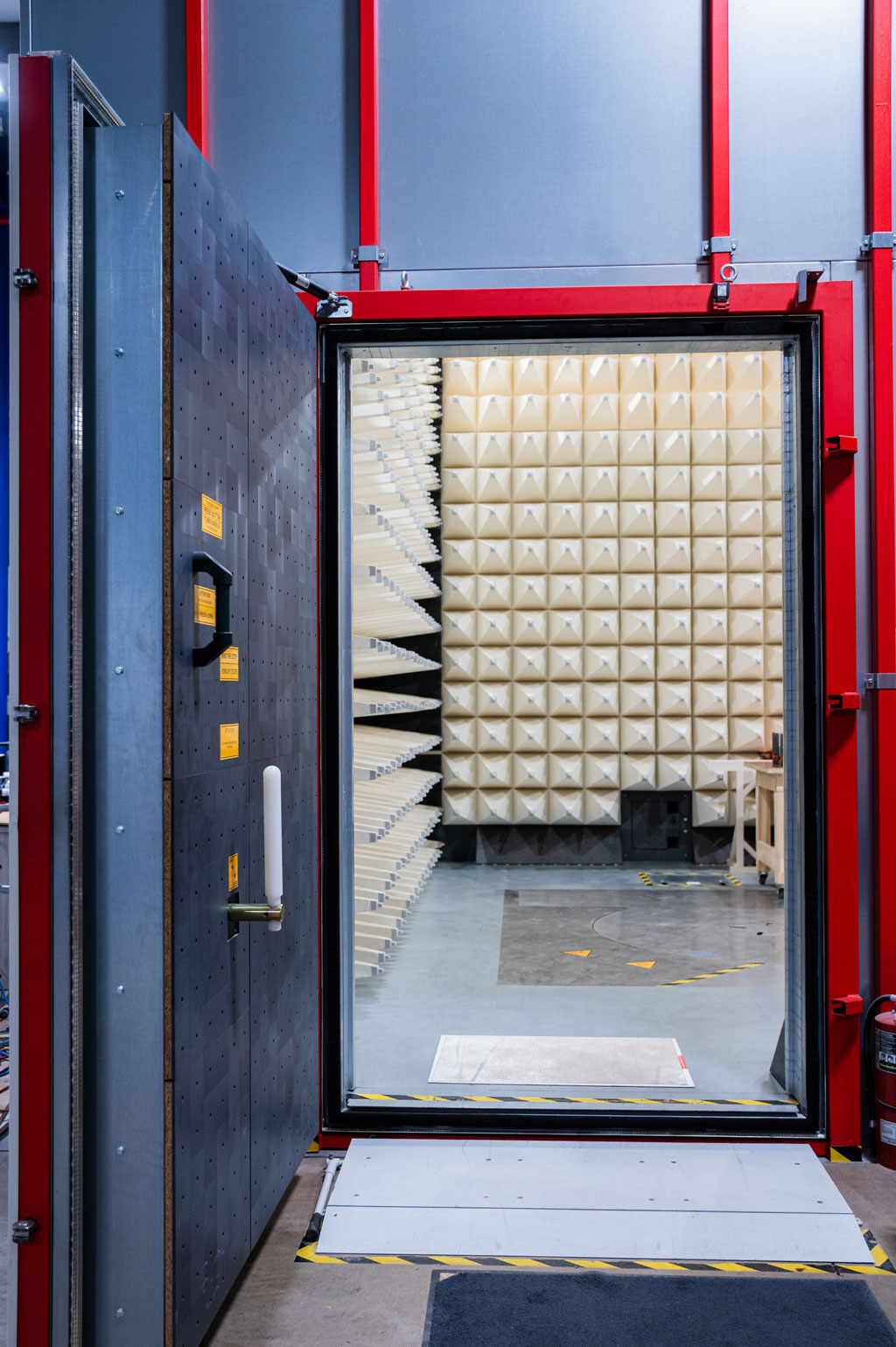
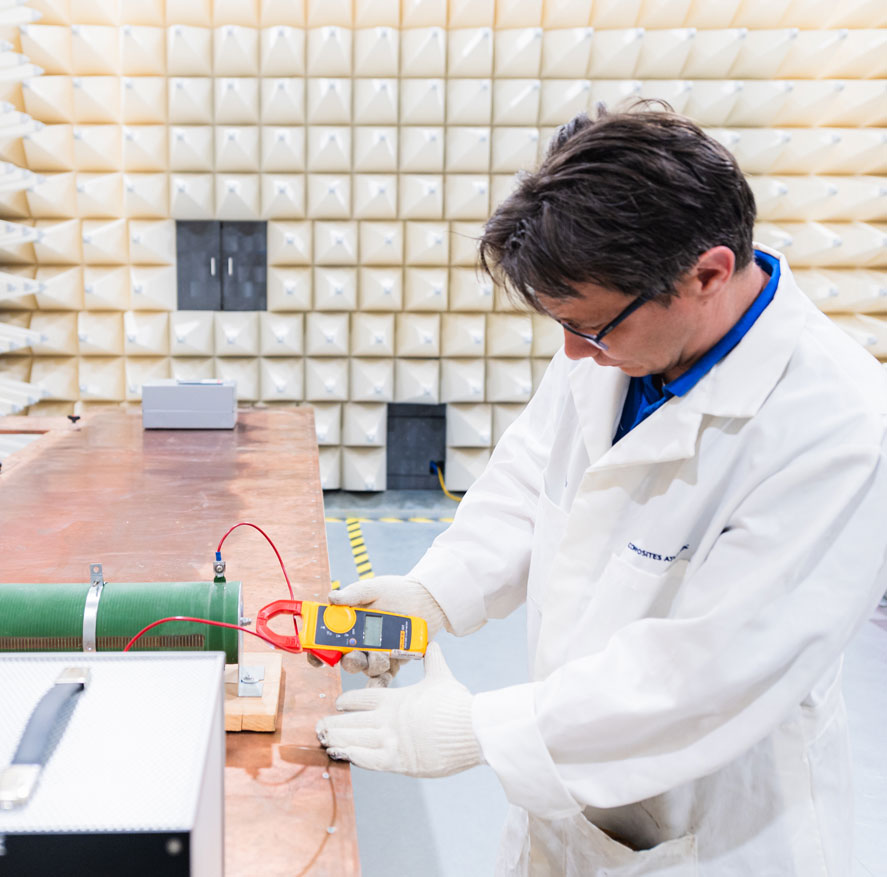
Our state-of-the-art facility features a Frankonia semi-anechoic EMC chamber designed for:
- Conducted emissions testing
- Conducted susceptibility testing
- Radiated emissions testing
- Radiated susceptibility testing
- Pre-compliance testing
These capabilities help manufacturers validate product performance, support certification requirements, and identify electromagnetic interference risks before deployment.
EMI and EMC Testing Capabilities
Our EMI and EMC testing services support a wide range of military, aerospace, marine, and commercial testing requirements.
Military EMI and EMC Testing Services
Our comprehensive EMI and EMC assessment solutions address diverse testing criteria for mission-critical aerospace, maritime, military, and industrial sectors.
From initial pre-compliance to final certification, we offer end-to-end testing across all core EMC disciplines: Radiated Emissions (RE), Conducted Emissions (CE), Radiated Susceptibility (RS), and Conducted Susceptibility (CS):
- CE101 - Audio Frequency Currents, Power Leads - 30 Hz – 10 kHz
- CE102 - Radio Frequency Potentials, Power Leads - 10 kHz – 10 MHz
- CE106 - Antenna Port - 10 kHz – 40 GHz
- CS101 - Power Leads - 30 Hz – 150 kHz
- CS106 - Conducted susceptibility, transients, power leads.
- CS109 - Structure Current - 60 Hz – 100 kHz
- CS114 - Bulk Cable Injection - 10 kHz – 200 MHz
- CS115 - Bulk Cable Injection, Impulse Excitation - Impulse transients
- CS116 - Damped Sinusoidal Transients, Cables and Power Leads - 10 kHz – 100 MHz
- CS117 - Lightning-Induced Transients, Cables and Power Leads - Lightning transients
- CS118 - Personnel Borne Electrostatic Discharge (ESD) - Direct Contact & Air ESD
- RE101 - Magnetic Field - 30 Hz – 100 kHz
- RE102 - Electric Field - 10 kHz – 18 GHz
- RE103 - Antenna Port, Spurious and Harmonic Outputs - 10 kHz – 40 GHz
- RS101 - Magnetic Field - 30 Hz – 100 kHz
- RS103 - Electric Field - 2 MHz – 40 GHz
- RS105 - Transient Electromagnetic Field (EMP) - High-altitude EMP transient
While MIL-STD-461 tests individual boxes, electronics, and sub-assemblies, MIL-STD-464 tests the entire platform or vehicle (the whole airplane, tank, ship, or missile system) integrated as one unit (Platform/System Level E³).
- 5.14 - System radiated emissions - RE101, RE102, RE103
- 5.2.2 - Shipboard internal electromagnetic environment (EME) - RS101, RS103
- 5.3 - External RF EME (HIRF) - RS103
- 5.4 - High-power microwave (HPM) sources - RS103
- 5.5 - Lightning (Indirect Effects) - CS117
- 5.6 - Electromagnetic pulse (EMP) - CS116
- 5.6 - Electromagnetic pulse (EMP) - RS105
- 5.7 - Subsystems and equipment electromagnetic interference (EMI) - CE101, CE102, CE106
UK equivalent of MIL-STD-461. If defense contractors are supplying land, sea, air, or man-wearable military hardware to the UK MoD or NATO allies using UK specs, they must qualify their electronics to DEF STAN 59-411.
- DCE01 - Conducted Emission, Primary Power Lines - 20 Hz – 150 MHz
- DCE02 - Conducted Emission, Control, Signal & Secondary Power Lines - 20 Hz – 150 MHz
- DCS01 - Conducted Susceptibility, Power Lines (Low Frequency) - 20 Hz – 150 kHz
- DCS02 - Conducted Susceptibility, Interconnect Cables (RF Injection) - 50 kHz – 400 MHz
- DCS03 - Conducted Susceptibility, Control & Signal Lines - High-frequency / pulsed cable injection
- DCS10 - Electrostatic Discharge (ESD) - Direct contact & air discharges
- DRE01 - Radiated Emissions, Electric Field (E-Field) - 10 kHz – 18 GHz
- DRE02 - Radiated Emissions, Magnetic Field (H-Field) - 20 Hz – 250 kHz
- DRS01 - Radiated Susceptibility, Magnetic Field (H-Field) - 20 Hz – 100 kHz
- DRS02 - Radiated Susceptibility, Electric Field (E-Field) - 10 kHz – 18 GHz (up to 40 GHz)
MIL-STD-704 - testing of mandatory limits for voltage, frequency, phase balance, and power quality on military aircraft. It ensures that onboard avionics and payload electronics operate safely without degrading, rebooting, or burning out due to the "dirty" power generated by engines and generators.
- LDC101 - Load Measurements
- LDC102 - Steady State Limits for Voltages
- LDC103 - Voltage Distortion Spectrum
- LDC104 - Total Ripple
- LDC105 - Normal Voltage Transients
- LDC201 - Power Interrupt
- LDC301 - Steady State Limit for Voltage
- LDC302 - Abnormal Voltage Transients
- LDC401 - Steady State Limits for Voltage
- LDC501 - Starting Voltage Transients
- LDC601 - Power Failure
- LDC602 - Phase Reversal
- SAC101 - Load and Current Harmonic Measurements
- SAC102 - Steady State Limits for Voltage and Frequency
- SAC104 - Voltage Modulation
- SAC105 - Frequency Modulation
- SAC106 - Voltage Distortion Spectrum
- SAC107 - Total Voltage Distortion
- SAC108 - DC Voltage Component
- SAC109 - Normal Voltage Transients
- SAC110 - Normal Frequency Transients
MIL-STD-1275 establishes the technical requirements for 28V DC electrical power systems in military ground vehicles, ensuring onboard electronics withstand severe power fluctuations.
- 5.3.1 - Operational Voltage Range
- 5.3.1 - Voltage Ripple (Injected & Emitted)
- 5.3.2 - Initial Engagement Surge (IES)
- 5.3.2 - Cranking Surges
- 5.3.3 - Injected Voltage Spikes
- 5.3.3 - Emitted Voltage Spikes
- 5.3.3 - Injected Voltage Surges ("Load Dump")
- 5.3.3 - Emitted Voltage Surges
- 5.3.4 - Reverse Polarity Test
- 5.2.4 / 5.3.10 - Grounding
- 5.3.1 - User Equipment Power Profile
- 5.3.10 - Line to Ground Voltage
- 5.3.10.1 - Insulation Resistance
- 5.3.2 - Current Waveform / Harmonic Distortion
- 5.3.3 - Voltage and Frequency Tolerance
- 5.3.4 - Voltage and Frequency Transient Tolerance and Recovery
- 5.3.5 - Voltage Spike Survival
- 5.3.6 - Emergency Conditions
- 5.3.7 - Pulsed Load / Inrush Current
- 5.3.8 - Voltage and Frequency Modulation
- 5.3.9 - Simulated Human Body Impedance Ground Current
DOD-STD-1399 establishes the standard interface requirements for AC low-voltage and medium-voltage electrical power systems onboard naval vessels.
- DCMFE - DC Magnetic Field Environment
Commercial EMI & EMC Testing Services
Comprehensive RTCA DO-160 Qualification for Flight-Ready Avionics & Airborne Systems:
- Section 16.0 - Power Input (Harmonics & Emission Tests) - DC to Audio Frequencies
- Section 16.0 - Power Input (Surges, Voltage Variations, Dropouts) - Power line transients & variations
- Section 17.0 - Voltage Spike - Transients on DC/AC power leads
- Section 18.0 - Audio Frequency Conducted Susceptibility - 10 Hz – 150 kHz
- Section 19.0 - Induced Signal Susceptibility (Interconnect Cable Coupling) - Magnetic/Electric field & spike induction
- Section 19.0 - Audio Frequency Magnetic/Electric Field (Equipment Case Exposure) - Power frequencies & harmonics
- Section 20.0 - RF Susceptibility (Conducted / Bulk Cable Injection) - 10 kHz – 400 MHz
- Section 20.0 - RF Susceptibility (Radiated / HIRF) - 100 MHz – 18 GHz (Anechoic or Reverb Chamber)
- Section 21.0 - Emission of RF Energy (Radiated) - 100 MHz – 6 GHz (up to 18 GHz depending on category)
- Section 21.0 - Emission of RF Energy (Conducted) - 150 kHz – 152 MHz
- Section 22.0 - Lightning Induced Transient Susceptibility - Pin Injection & Cable Bundle Waveforms
- Section 25.0 - Electrostatic Discharge (ESD) - Up to 15 kV direct contact/air discharge
Commercial, Medical & Automotive EMC Testing validates that electronic systems limit unwanted electromagnetic interference and remain resilient against surrounding electrical disturbances. ESL Labs provides pre-compliance testing across commercial, industrial, vehicular, and life-critical medical standards to aid in seamless market entry and regulatory approval.
- CISPR 11 / EN 55011 - Conducted & Radiated RF Emissions - Industrial, Scientific & Medical (ISM)
- CISPR 25 - Conducted Emissions (Voltage & Current Probe Method) - Automotive ESAs
- CISPR 25 - Radiated Emissions (ALSE Method, 150 kHz to 6 GHz) - Automotive ESAs
- CISPR 32 / EN 55032 - Conducted Emissions - AC/DC Mains Power Ports
- CISPR 32 / EN 55032 - Conducted Emissions - Ethernet, Telecommunication & Network Ports (via ISN)
- ISO 11452-2 - Radiated RF Immunity - ALSE Chamber Method
- ISO 11452-2 - Radiated RF Immunity - Radar Pulse Simulation
- ISO 11452-4 - Bulk Current Injection (BCI) Immunity
- ISO 11452-8 - Immunity to Magnetic Fields (DC to 150 kHz via Radiating Loops)
- ISO 10605 - Electrostatic Discharge (ESD) for Automotive Modules & Vehicles
- 60601-1-2 (Cl. 7.1) - Conducted and Radiated RF Emissions (CISPR 11 Compliance)
- 60601-1-2 (Cl. 7.2) - Harmonic Current Emissions & Voltage Flicker (IEC 61000-3-2 / 3-3)
- 60601-1-2 (Cl. 8.9) - Electrostatic Discharge Immunity (up to 15 kV Air / 8 kV Contact)
- 60601-1-2 (Cl. 8.9) - Radiated RF Electromagnetic Field Immunity (3 V/m to 28 V/m Proximity Fields)
- 60601-1-2 (Cl. 8.9) - Conducted RF Immunity (150 kHz to 80 MHz via CDN/Clamps)
- 60601-1-2 (Cl. 8.9) - Power Frequency Magnetic Field Immunity (30 A/m)
- 60601-1-2 (Cl. 8.9) - Voltage Dips, Interruptions, and Variations on Power Supply Input Lines
EMI & EMC Engineering Services
In addition to compliance testing, ESL Labs provides engineering support and electromagnetic troubleshooting services, including:
- EMC design support for systems, equipment, printed circuit boards, power systems, and cables
- EMI troubleshooting and mitigation
- System-level electromagnetic environmental effects (E3)
- Electromagnetic radiation hazards (RADHAZ / RF Safety)
- Indirect lightning and High Intensity Radiated Fields (HIRF) airworthiness testing
- Regulatory compliance support
- Emissions Security (EMSEC / TEMPEST)
What is EMI testing?
EMI testing evaluates electromagnetic emissions generated by a device that could interfere with nearby electronics.
What is EMC testing?
EMC testing verifies that equipment can operate properly within its electromagnetic environment without causing or experiencing interference.
What industries require EMI and EMC testing?
Industries including aerospace, defence, marine, industrial manufacturing, and electronics commonly require EMI and EMC compliance testing.
Can ESL Labs perform MIL-STD EMI testing?
Yes. ESL Labs supports MIL-STD-461G and related military EMC testing requirements.
Does ESL Labs provide pre-compliance testing?
Yes. We provide pre-compliance testing services to help identify potential EMI and EMC issues before formal certification testing.
Military and Aerospace Testing
- MIL-STD-461D / 462D test methods
- MIL-STD-461G testing
- DC magnetic field susceptibility
- Power quality test methods
- RTCA/DO-160G EMI test methods
Applications include surface ships, submarines, army aircraft, navy aircraft, space systems, and ground force equipment.
Commercial EMI and EMC Testing
- Commercial radiated and conducted immunity
- FCC Part 15B
- ICES-001 and ICES-003
- EN 55011 / CISPR 11
- EN 55032 / CISPR 32
We also provide commercial RF transmitter and receiver testing and ESD (electrostatic discharge) testing.