Expert Insights, Case Studies, and Technical Resources for Product Testing and Qualification
Whether you're preparing a product for qualification, researching testing standards, or looking for real-world examples of successful validation programs, our Resources library is here to help.
Explore expert articles, case studies, FAQs, guides, and technical insights covering environmental testing, EMI & EMC testing, shock and vibration testing, materials testing, and product qualification. Our goal is to help engineers, manufacturers, and project teams make informed decisions, reduce development risk, and build reliable products that perform in demanding environments.
Why Test eBook
Why Test eBook
Case Studies
See how ESL Labs has helped manufacturers identify design issues, achieve certification, improve product reliability, and reduce development risk through customized testing programs.

Environmental Testing FAQ
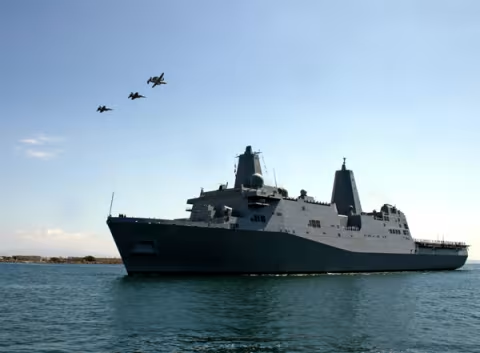
Expert Answers from a Leading Environmental Testing Company
Environmental testing is critical for proving product reliability in real-world conditions. At ESL Labs, we support aerospace, defence, marine, and industrial programs with advanced environmental testing services, MIL-STD qualification, and EMI & EMC testing.
This FAQ answers the most common questions about environmental testing, standards, and how to prepare your product for validation.
What is environmental testing and why is it important?
Environmental testing evaluates how products perform under real-world conditions such as temperature changes, humidity, vibration, corrosion, and shock. These tests help identify potential weaknesses before equipment is deployed in the field. Environmental testing improves product reliability, supports regulatory compliance, and reduces the risk of costly failures during operation.
What industries use environmental testing services?
Environmental testing is widely used in aerospace, defence, marine technology, transportation, industrial manufacturing, and electronics. Companies developing equipment for harsh or mission-critical environments rely on environmental testing to ensure their systems perform safely and reliably throughout their lifecycle.
What types of environmental conditions can be simulated during testing?
Environmental testing laboratories simulate conditions including extreme heat and cold, humidity, thermal shock, salt fog corrosion, solar radiation, vibration, mechanical shock, altitude (low pressure), blowing dust and sand, icing, and immersion. These tests replicate the stresses products experience during transportation, storage, and operational use.
When should environmental testing be conducted during product development?
Environmental testing is most effective when integrated early in the product development process. Early testing helps engineers identify design weaknesses before production, reducing redesign costs and shortening development timelines. It also helps organizations prepare for certification and regulatory qualification testing.
What standards are commonly used for aerospace and defence environmental testing?
Aerospace and defence products are typically tested according to standards such as MIL-STD-810, MIL-STD-461, MIL-STD-901, and RTCA DO-160. These standards define environmental and electromagnetic conditions equipment must withstand to operate safely in aircraft, naval vessels, and military systems.
What is MIL-STD testing?
MIL-STD testing refers to environmental and electromagnetic qualification tests defined by U.S. military standards. These tests evaluate how equipment performs under harsh conditions such as vibration, shock, extreme temperatures, and electromagnetic interference. Passing MIL-STD tests demonstrates that equipment is suitable for military or defence applications.
What is DO-160 testing?
RTCA DO-160 is a standard used to evaluate the environmental performance of airborne equipment. It includes tests for temperature, altitude, vibration, humidity, lightning, and electromagnetic interference. DO-160 testing helps ensure avionics and aircraft systems operate safely under the demanding conditions experienced during flight.
Why is shock testing required for naval equipment?
Naval shock testing verifies that equipment can survive the intense forces generated by nearby explosions or impact events. These tests ensure that critical systems installed on ships remain operational during extreme shock events, protecting crew safety and mission readiness.
What is mechanical shock testing?
Mechanical shock testing evaluates how equipment responds to sudden forces such as impacts, drops, or explosive shock waves. These tests simulate real-world events that products may experience during transportation, handling, or operational use.
What is vibration testing and why is it important?
Vibration testing simulates the repetitive motion products experience during operation or transportation. Equipment used in vehicles, aircraft, ships, and industrial systems must withstand continuous vibration without failure. Testing helps identify structural weaknesses, loose components, or resonance issues.
What is MIL-DTL-901E Medium Weight Shock testing?
MIL-DTL-901E Medium Weight Shock testing evaluates the ability of shipboard equipment to withstand high-impact shock events. It simulates explosive forces that naval equipment may experience during combat scenarios. This qualification is required for many systems installed on military vessels.
What is salt fog testing?
Salt fog testing evaluates how materials and coatings resist corrosion when exposed to saline environments. The test exposes products to a controlled salt mist to simulate marine and coastal conditions. It is commonly used to assess corrosion resistance for metals, coatings, and electronic enclosures.
What is thermal shock testing?
Thermal shock testing rapidly transitions products between hot and cold environments to identify failures caused by sudden temperature changes. This test helps engineers evaluate material expansion, contraction, and potential cracking or component failure.
What is accelerated weathering testing?
Accelerated weathering testing exposes materials to intense ultraviolet radiation, heat, and moisture to simulate years of outdoor exposure. This helps manufacturers evaluate long-term durability of plastics, coatings, and materials used in outdoor equipment.
What materials can be tested in environmental laboratories?
Environmental testing labs evaluate a wide range of materials including metals, composites, plastics, adhesives, coatings, fiberglass, carbon fiber, and Kevlar. Testing ensures these materials maintain their strength, flexibility, and performance under harsh environmental conditions.
What types of mechanical material tests are available?
Mechanical material testing typically includes tensile testing, compression testing, flexural testing, shear testing, and impact testing. These tests determine how materials behave under load and help verify that they meet required engineering specifications.
Why is material testing important for product development?
Material testing helps engineers select appropriate materials for specific operating environments. It verifies performance, identifies weaknesses, and ensures products meet industry standards. Testing also supports certification requirements and improves long-term product reliability.
What is EMI & EMC testing and why is it important?
EMI (Electromagnetic Interference) and EMC (Electromagnetic Compatibility) testing evaluates how electronic equipment emits and responds to electromagnetic energy. The goal is to ensure that devices operate properly without interfering with other systems. EMI & EMC testing is essential for industries such as aerospace, defence, marine technology, and telecommunications where reliable electronic performance is critical.
What types of equipment require EMI & EMC testing?
Many electronic systems require EMI & EMC testing before deployment, including avionics, defence electronics, communication systems, industrial controls, and marine equipment. Any device that generates or relies on electrical signals must be evaluated to ensure it does not create harmful electromagnetic interference and can operate safely alongside other electronic systems.
What standards are used for EMI & EMC compliance testing?
EMI & EMC testing is typically performed according to industry standards such as MIL-STD-461, RTCA DO-160, CISPR, and IEC standards. These standards define acceptable emission levels and immunity requirements for electronic equipment. Compliance testing verifies that products meet regulatory and operational requirements before being deployed in critical environments.
What makes ESL Labs different from other environmental testing laboratories?
ESL Labs provides comprehensive environmental and material testing services supported by advanced instrumentation and experienced engineering staff. Our facility supports aerospace, defence, marine, and industrial testing programs while maintaining strict calibration standards aligned with national and military specifications.
Can ESL Labs help design a custom testing program?
Yes. At ESL Labs, we work closely with engineering teams to interpret testing requirements and design custom test programs. This approach ensures that testing accurately reflects the environmental conditions products will face during real-world operation.
How can companies prepare equipment for environmental testing?
Before testing, companies should review applicable standards, define operational limits, and ensure products are properly instrumented for monitoring during tests. Consulting with a testing laboratory early in the process helps create an effective test plan and reduces the risk of unexpected failures.